What is moxibustion therapy?
What Is Moxibustion?
Moxibustion (灸法, jiǔ fǎ) is a form of heat therapy used in Traditional Chinese Medicine (TCM) that involves burning dried mugwort — known as moxa (艾, ài) — on or near the skin at specific acupoints. With a history spanning over 2,500 years, moxibustion predates acupuncture and remains one of the most widely practiced TCM therapies in China, Japan, Korea, and increasingly around the world.
The principle is straightforward: by applying controlled heat to acupuncture points, moxibustion stimulates the flow of Qi (vital energy) and blood through the body’s meridian system. In TCM theory, many health problems arise from cold, dampness, or stagnation — and moxibustion’s warming nature directly counteracts these pathogenic factors.
If you’re completely new to moxibustion, start with our Moxibustion at Home Beginner’s Guide for a step-by-step introduction.
A Brief History of Moxibustion
Moxibustion is one of the oldest documented medical therapies in human history. The earliest records appear in the Mawangdui Silk Texts (马王堆帛书, c. 168 BCE) discovered in Changsha, China. The foundational TCM text Huangdi Neijing (黄帝内经, The Yellow Emperor’s Inner Canon, c. 200 BCE) extensively references moxibustion as a primary therapeutic method.
Throughout Chinese dynasties, moxibustion evolved from simple direct burning of moxa on the skin ( scarring moxibustion ) to gentler indirect methods. By the Tang Dynasty (618–907 CE), specialized moxa sticks and tools began appearing. Today, modern moxibustion includes smokeless varieties, electronic moxa devices, and precision temperature-controlled instruments — yet the core principle remains unchanged.
How Does Moxibustion Work?
Traditional Chinese Medicine Perspective
In TCM theory, moxibustion works through three primary mechanisms:
- Warms the meridians and dispels cold (温经散寒): Cold is considered a major pathogen in TCM. Moxa heat penetrates deep into meridians, dispersing cold-dampness that causes pain, stiffness, and digestive weakness.
- Promotes Qi and blood circulation (行气活血): Heat stimulates the smooth flow of Qi and blood, resolving stagnation — the TCM equivalent of improving microcirculation and reducing inflammation.
- Tonifies Yang and raises collapsed Qi (温阳固脱): Moxibustion strengthens the body’s Yang energy (warming, activating force), making it particularly useful for fatigue, weak immunity, and chronic conditions.
Modern Scientific Understanding
Contemporary research, explored in depth in our article on What Science Says About Moxibustion, has identified several physiological mechanisms:
- Thermal effect: Far-infrared radiation from burning moxa penetrates 2–4 cm into tissue, increasing local blood flow and reducing muscle tension.
- TRPV1 receptor activation: Moxa heat activates heat-sensitive TRPV1 channels, triggering local anti-inflammatory and analgesic responses.
- Immunomodulation: Studies show moxibustion can regulate cytokine levels and enhance natural killer (NK) cell activity.
- Autonomic nervous system regulation: Moxibustion at specific points (e.g., ST36 Zusanli) modulates sympathetic/parasympathetic balance.
Types of Moxibustion
Moxibustion comes in several forms. For a detailed buying guide, see our article on Types of Moxa Products. Here’s a quick overview:
Moxa Sticks (艾条)
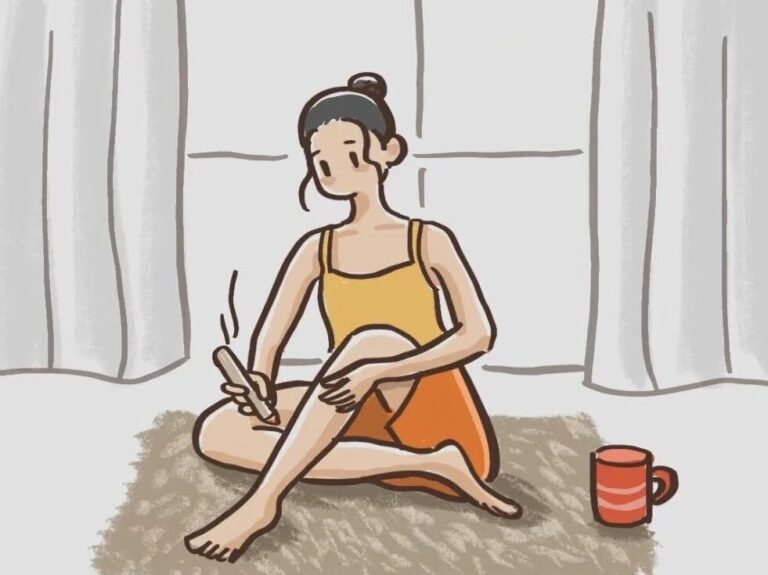
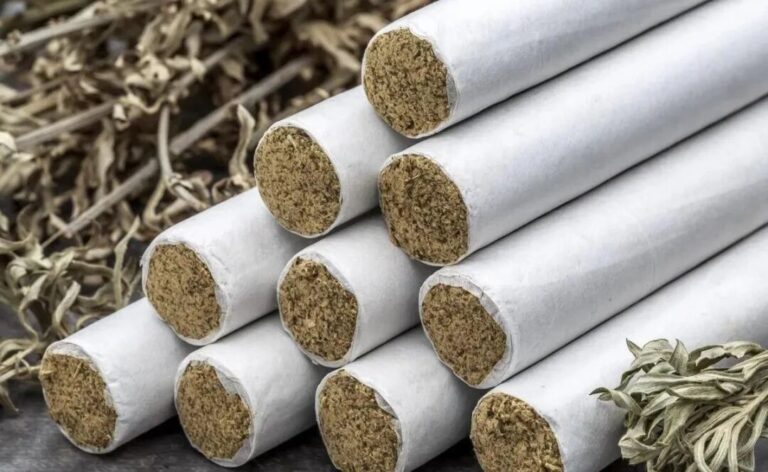
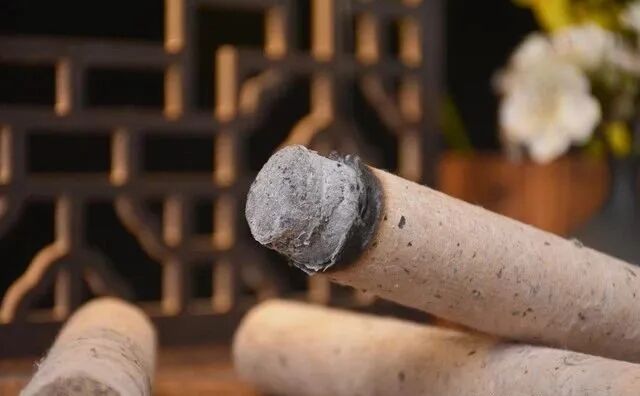
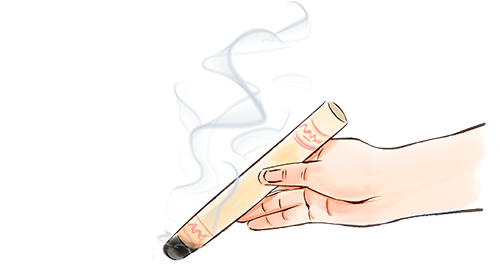
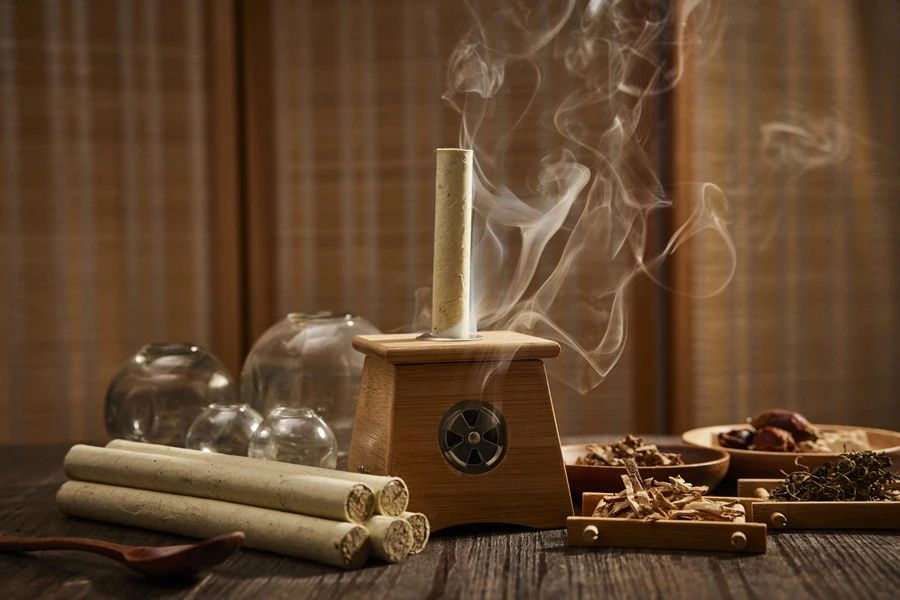
The most common form for home use. A cigar-shaped roll of compressed moxa wool wrapped in paper. The practitioner holds the lit stick 1–3 cm above the skin, moving it in circles or a “sparrow-pecking” motion over acupoints. Easy to learn, versatile, and widely available. If you’re new to using moxa sticks, read our How to Use Chinese Moxibustion guide.
Moxa Cones (艾炷)
Small cone-shaped amounts of moxa placed directly on the skin (direct moxibustion) or on top of a barrier like ginger, garlic, or salt (indirect moxibustion). Cones provide intense, localized heat and are typically used in clinical settings or by experienced practitioners.
Moxa Boxes (艾盒)
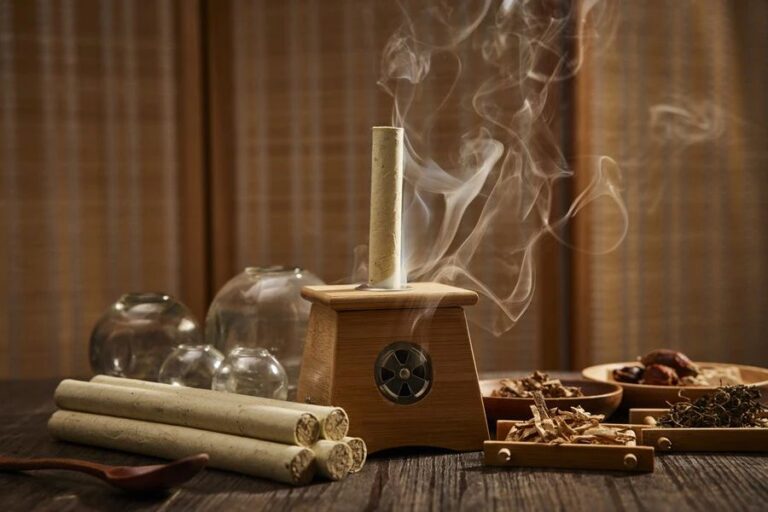
A wooden or metal box with a metal screen that holds smoldering moxa. Placed on larger body areas like the abdomen or lower back, moxa boxes provide gentle, diffused warmth — ideal for treating broad areas and for beginners who want a hands-free option.
Smokeless & Electric Moxa
Modern innovations include carbonized moxa sticks that produce minimal smoke and electronic devices that deliver precise infrared heat. Check our comparison of Smokeless vs Traditional Moxa Sticks if smoke is a concern.
What Can Moxibustion Treat?
Moxibustion has a broad range of applications. Our detailed guide What Is Moxibustion Used to Treat covers specific conditions, but here are the major categories:
- Pain conditions: Arthritis, lower back pain, neck and shoulder tension, knee osteoarthritis
- Digestive disorders: IBS, chronic diarrhea, poor appetite, stomach cold, bloating
- Women’s health: Menstrual cramps, irregular periods, breech presentation (with clinical evidence), fertility support
- Respiratory issues: Asthma, seasonal allergies, frequent colds, chronic bronchitis
- Immune & general wellness: Chronic fatigue, weakened immunity, cold hands and feet, general weakness
For more on the physiological benefits, read about the Effects of Moxibustion on your body.
Moxibustion vs Acupuncture: What’s the Difference?
Both acupuncture and moxibustion work on the same meridian system and often use the same acupoints — but they differ fundamentally in their mechanism:
| Aspect | Moxibustion | Acupuncture |
|---|---|---|
| Primary stimulus | Heat (thermal + infrared) | Mechanical (needle insertion) |
| Best for | Cold, dampness, deficiency patterns | Stagnation, excess, acute pain |
| Invasiveness | Non-invasive (indirect methods) | Minimally invasive (needles) |
| At-home feasibility | High (with proper learning) | Low (requires training) |
| Sensation | Warm, relaxing | De qi sensation (aching, tingling) |
In clinical practice, the two are often combined — a treatment known as “warming needle” (温针灸, wēn zhēn jiǔ), where a small moxa cone is placed on the handle of an inserted acupuncture needle, conducting heat directly into the acupoint.
Is Moxibustion Safe?
When practiced correctly, moxibustion is a remarkably safe therapy with a low risk profile. However, certain precautions are essential:
- Burn risk: Always maintain a safe distance (1–3 cm) between the lit moxa and skin. Use a protective barrier like a moxa box screen if you’re a beginner.
- Smoke and ventilation: Traditional moxa produces smoke. Always practice in a well-ventilated room. If smoke is a concern, consider smokeless moxa products.
- Contraindicated points: Avoid moxibustion on the face, head, and near major blood vessels without professional guidance.
- Special populations: Pregnant women should avoid moxibustion on the lower abdomen and lumbosacral region unless specifically indicated (e.g., breech correction by a trained professional).
- Skin sensitivity: People with diabetic neuropathy or reduced skin sensation should use extra caution with heat therapy.
Read our detailed guide on What Not to Do After Moxibustion for post-treatment care tips.
How to Get Started with Moxibustion at Home
Starting a moxibustion practice at home is easier than you might think. Here’s a simple roadmap:
- Learn the basics: Start with our Moxibustion at Home Beginner’s Guide.
- Get quality moxa: Not all moxa is equal. Learn how to Identify High-Quality Moxibustion Sticks and Where to Buy Moxa Sticks.
- Choose your tools: Browse our Types of Moxa Products guide to pick what suits you.
- Master the technique: Follow the step-by-step instructions in How to Use Chinese Moxibustion.
- Start simple: Begin with 10–15 minute sessions on well-known points like ST36 (Zusanli) or CV4 (Guanyuan), 2–3 times per week.
Frequently Asked Questions
Does moxibustion hurt?
No. Indirect moxibustion (the most common form) produces a gentle, pleasant warmth — similar to a heating pad but more penetrating. You should only feel comfortable heat, never pain or burning.
How long does a moxibustion session take?
A typical at-home session lasts 15–30 minutes per acupoint area. Clinical sessions may run 30–60 minutes. For detailed timing guidance, see How Long to Use Moxa.
Can I do moxibustion every day?
For acute conditions, daily moxibustion for 5–7 days is common. For maintenance and wellness, 2–3 sessions per week is sufficient. Read more in Can I Do Moxibustion Every Day?
Does moxibustion smell bad?
Burning moxa has a distinct herbal, smoky aroma — often described as earthy or similar to cannabis (since mugwort and cannabis are botanical relatives). Many people find it pleasant and calming. If the smell is a concern, smokeless moxa products are available.
Is moxibustion scientifically proven?
A growing body of research supports moxibustion’s effectiveness for specific conditions, particularly pain management, breech correction, and immune modulation. See our Science of Moxibustion article for a detailed review of clinical evidence.
Conclusion
Moxibustion is one of the most accessible, time-tested therapies in Traditional Chinese Medicine. With a 2,500-year track record and growing scientific validation, it offers a safe, non-invasive way to address pain, digestive issues, women’s health concerns, and immune weakness — all from the comfort of your home.
Whether you’re dealing with chronic back pain, poor digestion, or simply want to strengthen your body’s natural resilience, moxibustion is worth exploring. Start with quality moxa products, learn proper technique, and listen to your body’s response.
Ready to begin? Read our Beginner’s Guide or explore Moxa Products to find the right tools for your journey.