Moxibustion Acupoints: A Beginner’s Guide to the 10 Most Useful Points
Ask anyone who practices moxibustion regularly what makes the difference between a session that works and one that doesn’t, and you’ll get the same answer: the points you choose. Moxa heat applied to the right acupoint does real work. The same stick waved randomly over the skin does very little.
The trouble is that classical acupuncture charts show over 360 points — enough to discourage any beginner. The good news: for home moxibustion, roughly ten points cover the vast majority of everyday needs, from cold hands and poor digestion to period cramps and low energy.
This guide walks through those ten. For each one, you’ll learn where it is (in plain language, using your own hand spans and finger widths), what it’s traditionally used for, and how to apply moxa to it safely.
Completely new to moxibustion? Read our beginner’s complete guide to moxibustion at home first, and check how to use a moxa stick for the basic holding technique.
How to Find Points on Your Body: The Two Rules
Before the list, two measurement habits that make point-finding easy. Traditional Chinese medicine measures the body in “cun” — proportional units based on your own fingers, so they work whether you’re tall, short, adult, or child:
- One thumb-width (1 cun): the width of your thumb at the knuckle.
- Four finger-widths (3 cun): your four fingers held together, measured across the knuckles.
Because these are proportional to your own body, the same “3 cun below the kneecap” lands correctly on every person. The second rule: points are often tender. When you press the right spot, there’s frequently a dull ache or a pleasant soreness that the surrounding area doesn’t have. That feedback is your best confirmation.
1. Zusanli (ST36) — The Point of Longevity
Where: On your lower leg, four finger-widths below the bottom of your kneecap, one thumb-width toward the outside of your shin bone.
What it’s known for: If you learn only one point, learn this one. Zusanli is the most famous point in Chinese medicine — the point of longevity, digestion, and daily energy. It’s traditionally used for tired legs, weak digestion, low immunity, and the general run-down feeling after illness.
How to moxa it: 10–15 minutes per leg. This point is safe, comfortable, and forgiving — which is exactly why generations of Chinese families have moxa’d it as a daily wellness routine.
2. Guanyuan (CV4) — The Gate of Original Energy
Where: On the lower abdomen, four finger-widths below the navel, on the midline.
What it’s known for: Guanyuan is the classic warming point — the one to think of for cold lower abdomen, period cramps, frequent urination, and that deep-chilled feeling some people carry in winter. In TCM terms it stores the body’s root energy; in practical terms, it’s the point that makes your belly feel warm.
How to moxa it: 15–20 minutes, gentle circling motion. Note for women: excellent for menstrual cold-type cramps, but avoid during heavy menstruation and pregnancy.
3. Qihai (CV6) — The Sea of Energy
Where: Directly next door: two finger-widths below the navel, on the midline.
What it’s known for: Functionally a sibling of Guanyuan, Qihai is used for fatigue, low stamina, and mild prolapse-related discomfort. Many practitioners simply treat CV4 and CV6 together as one warm abdominal zone.
How to moxa it: Same session as Guanyuan, splitting your time between the two.
4. Shenque (CV8) — The Navel Point
Where: The center of your navel. Yes, really — the belly button is itself an acupoint.
What it’s known for: Warming the core, easing diarrhea and bloating, and — this is the famous one — reviving chilled hands and feet from the inside.
Important: never place a moxa cone directly on the navel skin at home. Use an indirect method: a moxa stick held 3 cm above, or a moxa box resting over the whole lower abdomen. The navel skin is thin and sensitive.
5. Zhongwan (CV12) — The Stomach’s Meeting Point
Where: Midline of the abdomen, halfway between the navel and the bottom of the breastbone (roughly eight finger-widths above the navel).
What it’s known for: Everything digestive: overeating, bloating, acid reflux, mild gastritis discomfort, poor appetite. If your stomach complains after meals, this is the point.
How to moxa it: 10–15 minutes, ideally 30–60 minutes after eating rather than on a full stomach.
6. Sanyinjiao (SP6) — The Three Yin Crossing
Where: Inner lower leg, four finger-widths above the highest point of the inner ankle bone, just behind the shin bone’s inner edge.
What it’s known for: The classic women’s health point — irregular periods, PMS, cold-type menstrual cramps — and also insomnia and edema (puffy legs). It’s the meeting point of three meridians tied to the liver, spleen, and kidney.
How to moxa it: 10–15 minutes per leg. Strictly avoid during pregnancy — this point is contraindicated for pregnant women in both acupuncture and moxibustion.
7. Yongquan (KI1) — The Bubbling Spring
Where: The sole of the foot, in the depression that appears when you curl your toes — roughly the front third of the sole.
What it’s known for: The only major point on the sole, Yongquan draws energy downward. It’s the go-to point for insomnia, dizzy headaches, heat in the upper body, and the “can’t fall asleep because my mind is racing” state. Warmth here feels surprisingly relaxing.
How to moxa it: 5–10 minutes per foot before bed. The sole is sensitive — keep the stick slightly further away and keep it moving.
8. Dazhui (GV14) — The Meeting of All Yang
Where: Back of the neck, in the hollow just below the spinous process of the 7th cervical vertebra — the prominent bone you feel at the base of the neck when you tilt your head forward.
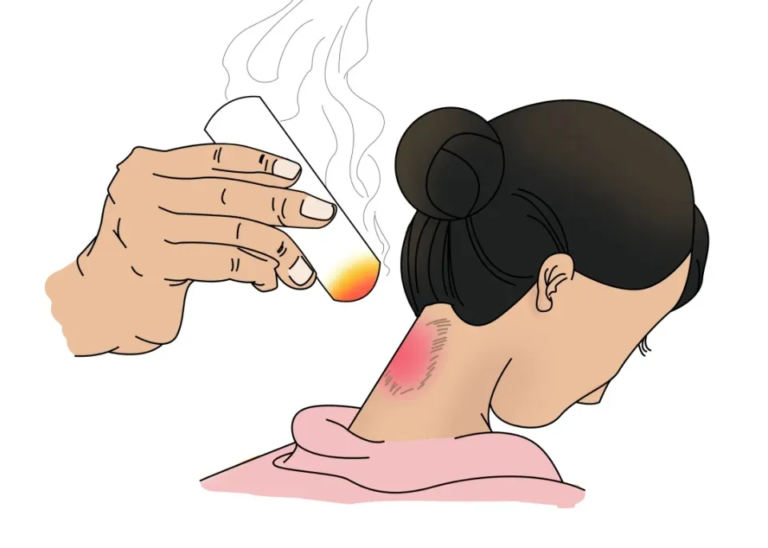
What it’s known for: The classic “catching a cold” point. Dazhui is used at the first sign of chills, runny nose, and stiff neck — the goal is to warm the body early, before the cold “settles in.” Also used for chronic neck and shoulder tension.
How to moxa it: 10 minutes. Hard to reach on yourself — ask a family member, or use a moxa box designed for the upper back.
9. Shenshu (BL23) — The Kidney Shu Points
Where: Lower back, on both sides of the spine, at the level of your waist (level with the navel roughly), about two finger-widths out from the spine. There’s often a natural hollow there.
What it’s known for: Sore, weak lower back; cold kidneys; age-related fatigue; frequent night urination. In TCM this is the support point for the body’s deepest reserve of vitality.
How to moxa it: A moxa box is by far the best tool here — it covers both points at once. 15–20 minutes.
10. Hegu (LI4) — The Common Point
Where: Back of the hand, in the fleshy web between thumb and index finger. Press around — the tender spot is the point.
What it’s known for: Headaches (especially frontal), toothache, facial issues, and general pain anywhere — Hegu is the most commonly used point in all of acupuncture. For moxibustion, it’s useful for tension headaches with a cold quality.
How to moxa it: 5–10 minutes per hand. Avoid during pregnancy.
Quick Reference Table
| Point | Location | Primary Use | Time |
|---|---|---|---|
| Zusanli (ST36) | Below knee, outer shin | Digestion, energy, immunity | 10–15 min |
| Guanyuan (CV4) | 4 fingers below navel | Warming, cramps, cold abdomen | 15–20 min |
| Qihai (CV6) | 2 fingers below navel | Fatigue, stamina | 10–15 min |
| Shenque (CV8) | Navel center | Core warmth, digestion | Indirect only |
| Zhongwan (CV12) | Halfway navel to sternum | Bloating, reflux, appetite | 10–15 min |
| Sanyinjiao (SP6) | 4 fingers above inner ankle | Women’s health, insomnia | 10–15 min |
| Yongquan (KI1) | Sole, front third | Insomnia, racing mind | 5–10 min |
| Dazhui (GV14) | Base of neck | Early cold, stiff neck | 10 min |
| Shenshu (BL23) | Lower back, both sides | Weak back, deep fatigue | 15–20 min |
| Hegu (LI4) | Hand web, thumb side | Headache, toothache | 5–10 min |
Which Points Should You Start With?
Don’t try all ten at once. Pick a goal and let it choose the points:
- General wellness, just starting out: Zusanli only. Daily, both legs. Master this before expanding.
- Digestive complaints: Zhongwan + Zusanli.
- Cold hands and feet: Guanyuan + Qihai (abdomen), then Zusanli.
- Period cramps (cold type): Guanyuan + Sanyinjiao — but never during pregnancy.
- Sore lower back: Shenshu with a moxa box.
- Insomnia: Yongquan before bed.
- Feeling a cold coming on: Dazhui at the very first chill.
For how long and how often to treat, see our frequency guide for safe practice and how long a session should last.
Safety Rules That Apply to Every Point
- Temperature discipline: the heat should feel pleasantly warm, never burning. If you flinch, pull back. See safety tips and precautions.
- Pregnancy: Sanyinjiao and Hegu are strictly avoided; the abdomen and lower back are off-limits entirely. When in doubt, don’t.
- Face, chest, and mucous membranes: no moxa on the face, over major blood vessels you can see, or anywhere the heat can’t easily dissipate.
- Numb skin: never moxa areas with reduced sensation — you can burn yourself without feeling it.
- After the session: drink warm water, keep covered, avoid cold drinks and cold wind for an hour. Our guide on what not to do after moxibustion covers this in detail.
- Serious conditions: home moxibustion is for everyday wellness. Persistent pain, unexplained symptoms, or chronic disease deserve a qualified practitioner — and moxibustion can complement that care, not replace it. For what the evidence actually supports, read what science says about moxibustion.
Frequently Asked Questions
Do I need to hit the point exactly?
No — and this is a relief for most beginners. The effective zone around each point is roughly the size of a thumb pad. Being half a finger-width off still delivers most of the benefit, which is why the tender-spot method works so well.
Can I treat several points in one session?
Yes, but keep the total under about 30–40 minutes as a beginner. Two to three points is a sensible session. More isn’t better — it’s just longer and riskier for fatigue.
Should the points be on both sides of the body?
For paired points (Zusanli, Sanyinjiao, Shenshu, Hegu), yes, treat both sides — either in the same session or alternating. Unpaired midline points (Guanyuan, Zhongwan, Dazhui) are single locations.
How will I know the moxibustion is working?
Local warmth and reddening of the skin during treatment are normal and expected. Over days to weeks, people typically report the target complaint easing — digestion settling, hands staying warmer, sleep deepening. If you notice increased dryness, agitation, or poor sleep after sessions, you’re likely overdoing the total time. See what moxibustion does for your body.
Which moxa product is best for these points?
A moxa stick handles all ten points in this guide. A moxa box earns its keep for the back and abdominal points. For the options, see types of moxa products and where to buy moxa sticks.
Start Simple, Stay Consistent
The beginners who get real results from moxibustion share one habit: they didn’t try to learn everything. They picked Zusanli, sat down with a moxa stick a few evenings a week, and let the practice grow from there. Ten points sounds like a lot — but as a starting point, one point, done consistently, is plenty.
→ Full beginner’s guide: moxibustion at home →
→ How moxa sticks actually work: TCM theory meets modern science →